
Redacted layout showing CTQ callouts, datums, and how pass/fail is stated.
Case study • CTQ evidence • Export-ready delivery
Case Study: Vacuum Chuck Subplate (Flatness‑Critical + Groove Features)
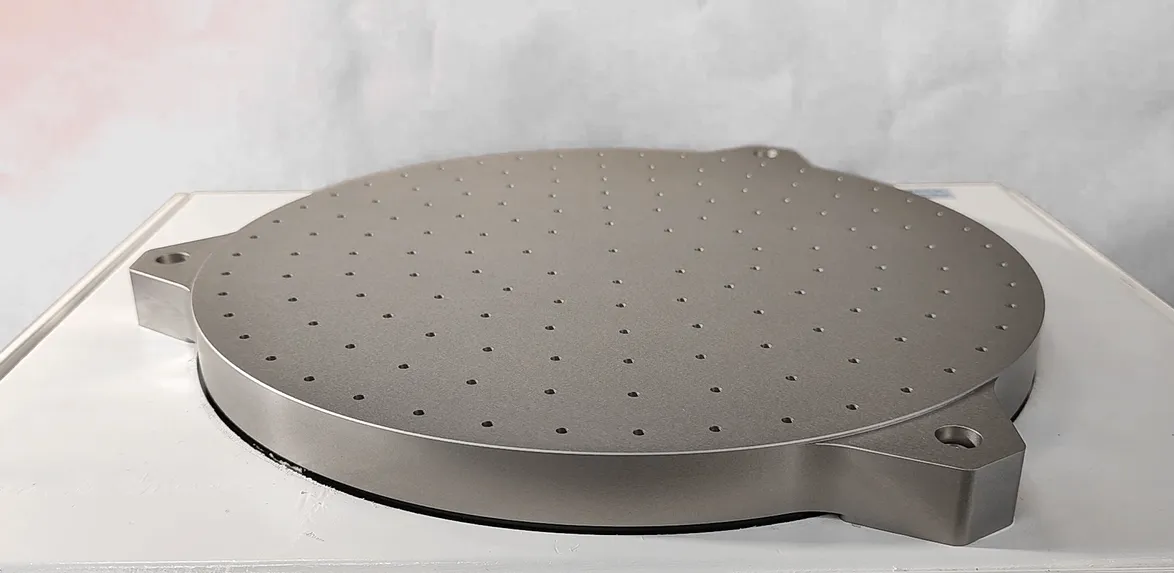
An anonymized program where a vacuum chuck subplate required stable flatness, consistent sealing grooves, and CTQ inspection evidence for a U.S. tool-build team.
Program snapshot
Customer: Semiconductor equipment integrator (U.S. program; customer name withheld)
Part: Vacuum chuck subplate used in tool assembly; interfaces with sealing grooves and alignment features
Why it mattered: Small deviations in flatness or groove geometry can create leak paths, misalignment, or calibration drift during tool setup
SEMIX role: Manufacturing planning, CNC machining, CTQ inspection planning, and documentation for receiving
| Field | Details (public) |
|---|---|
| Material / finish | Anonymized (share under NDA if needed) |
| Size envelope | Anonymized (available under NDA) |
| Qty range | Prototype to low-volume programs (anonymized) |
| CTQ focus | Datums + functional features (CTQs defined at RFQ) |
| Tolerance & verification | Tight/critical features verified on CTQ-focused report (ranges shared under NDA) |
| Lead time | Quoted per RFQ; schedule aligned to customer gate dates (ranges under NDA) |
| Evidence pack | CTQ report • CoC • material/finish certs (as applicable) • packaging notes |
Key requirements
| Area | Requirement |
|---|---|
| Geometry integrity | Flatness and parallelism controlled on functional surfaces (per drawing CTQs) |
| Sealing features | O‑ring grooves and sealing lands required consistent width/depth and clean edges |
| Surface quality | Functional surfaces required controlled finish and careful handling to prevent nicks |
| Documentation | CTQ inspection report and revision traceability for U.S. receiving |
| Schedule | Prototype-to-pilot build with short iteration cycles |
How we executed
SEMIX approached the build as a controlled workflow: confirm CTQs, plan measurement methods, and prevent revision drift.
- NDA-first onboarding: confirmed confidentiality requirements and received controlled drawing/model revisions.
- Contract review + CTQ mapping: identified functional surfaces, sealing grooves, and alignment datums as CTQs.
- Routing design: planned machining to protect datum structure and minimize distortion risk.
- In‑process checks: verified critical features before finishing operations to prevent late-stage rework.
- CTQ inspection plan: aligned measurement methods to CTQs and prepared a receiving-friendly report format.
- Packaging discipline: protected functional surfaces and labeled by revision/PO line for receiving.
Quality evidence and documentation
To make receiving easy for a U.S.-based program, we shipped with evidence aligned to CTQs and revision control.
- CTQ inspection report aligned to functional surfaces and sealing groove features
- Certificate of Conformance (CoC) referencing drawing revision and material/finish as specified
- Revision traceability across quote → PO → inspection report
- Protective packaging to prevent damage to sealing lands and datums during transit
Evidence pack preview (redacted)
On request, we can share redacted examples of the exact report formats our U.S. buyers receive—so your receiving team knows what to expect.
Revision- and PO-linked CoC format used for receiving acceptance.
Redacted packaging notes for protection, labeling, and kitted shipments (if applicable).
Outcome
- Functional surfaces received without damage due to packaging rules and handling discipline
- Receiving team could verify acceptance quickly using a CTQ-focused inspection report
- Iteration cycles shortened because assumptions and CTQs were written clearly and reused for the next build
Outcome metrics are anonymized. The point is the workflow: stable routing, CTQ measurement, and receiving-ready documentation.
Outcome highlights
Evidence formatted for receiving review; CTQs highlighted to reduce back-and-forth.
CTQ inspection plan executed; CoC and required certs packaged with the shipment.
Delivery and documentation aligned to the customer’s internal gate / PO flow-down.
Deep dive (technical briefs)
If you want the engineering rationale behind the controls used in this program, start with these related briefs from our Technical Academy:
-
ISO 230‑3 Thermal Effects | Warm‑Up Protocols That Protect Tolerances
A production-grade approach to thermal drift control using ISO 230‑3 concepts: warm-up routines, drift mapping, inspection timing, and restart rules for CNC machining in Vietnam serving U.S./EU buyers.
Read the full brief
-
Helium Leak Testing for Vacuum Parts | ISO 20485 + ASTM E499 Applied
Applied helium leak testing for vacuum hardware: method selection, background control, calibration checks, stabilization timing, and dispute-proof reporting using ISO 20485 and ASTM E499 principles.
Read the full brief
-
Decision Rules with Measurement Uncertainty | ISO 14253‑1 + ILAC G8 + GUM
Applied guide to uncertainty-based decision rules: guard bands, false accept/reject risk, and dispute-proof statements of conformity for precision CNC machining suppliers serving U.S./EU buyers.
Read the full brief
-
Product Cleanliness for Machined Parts | ISO 14644 & IEST‑STD‑CC1246
Applied contamination control for CNC machined parts: specify cleanliness levels, control particle sources, verify by extraction, and design packaging/handling workflows for semiconductor-adjacent supply chains.
Read the full brief
Evidence patterns (technical case studies)
Incident-style write-ups that show how SEMIX handles common failure modes and prevents receiving disputes:
-
Case Study (Semiconductor/Vacuum): Flatness Dispute Solved | Thermal State + Decision Rules
Flange flatness passed at supplier but failed at customer. Root cause traced to thermal-state mismatch and missing uncertainty-based decision rules. Includes corrective actions and reporting template.
Read the case
-
Case Study (Vacuum): Helium Leak “False Fail” | Fixture Background Dominated Signal
Apparent helium leak failures traced to fixture background helium and inconsistent stabilization. Corrected using disciplined baseline checks and ISO 20485 / ASTM E499 method logic.
Read the case
Documentation templates (print-to-PDF)
Want consistent receiving-ready evidence? These templates show typical formats SEMIX can provide with shipments (redacted samples available under NDA):
-
Certificate of Conformance (CoC) template
Buyer-friendly CoC with clear scope, drawing revision reference, and statement of conformity.
Open template
-
Inspection plan (CTQ) template
Characteristic table with method, sampling, decision rules, and reaction plans—built for high-trust programs.
Open template
-
Final inspection report template
A report structure that reduces disputes: conditions, CTQ highlights, and declared decision rules.
Open template
-
Packaging & shipping checklist template
Packaging spec, label control, photos, and shipment signoff for export-ready delivery.
Open template