
Preview sample formats for CoC, CTQ inspection reports, and packaging checklists.
ISO 9001 QMS • Inspection evidence • Export-ready delivery
5‑Axis Machining in Vietnam
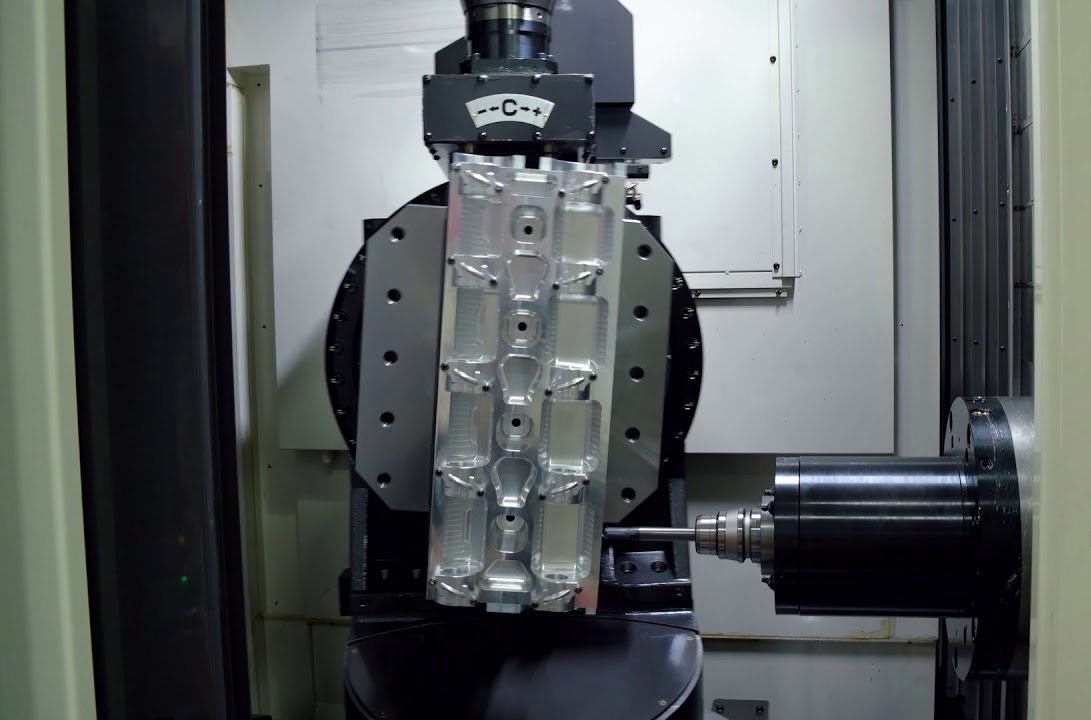
Simultaneous 5‑axis machining in Vietnam for complex geometry, fewer setups, and tighter positional control—supported by post control, fixture strategy, and orientation‑aware inspection evidence.
Precision machining
5-axis capable
Inspection reports
Export-ready packaging
Proof
Evidence you can request at RFQ
Ask how 5‑axis accuracy is validated across orientations—and how SEMIX reduces setups to protect positional requirements.
Overview
What you get with SEMIX
5‑axis machining is one of the most effective ways to reduce setup count on complex parts. Fewer setups often means tighter positional control, reduced cumulative error, and more consistent surfaces—especially on contoured geometry.
SEMIX provides 5‑axis machining in Vietnam for customers who need not only capability, but also predictable execution and documentation aligned to global receiving standards.
What is 5-axis machining?
Simultaneous 5‑axis machining for complex geometry
5‑axis machining allows the tool and part to move relative to each other in more directions, enabling complex geometry to be machined in fewer setups. Fewer setups often means better positional control, better surface consistency, and less risk of cumulative error.
- Complex contoured surfaces and multi‑angle features
- Fewer setups to reduce error and cycle time
- Improved access to features that are hard to reach on 3‑axis
When to choose 5-axis
Best-fit applications
When positional tolerances and relational accuracy matter across many faces, setup reduction is a major quality advantage.
5-axis tool orientation can improve surface finish consistency on complex curves and pockets.
5-axis can sometimes consolidate what would otherwise be multiple parts or setups, reducing total cost.
We align machining strategy with how features will be inspected and reported.
Planning & verification
Programming, simulation, and risk control
5-axis machining requires disciplined planning to protect quality and prevent late surprises.
- Tool access review to avoid collisions and excessive tool reach.
- Fixturing strategy to stabilize datums and reduce distortion risk.
- CAM verification to validate toolpaths and reduce risk before cutting metal.
- Inspection plan that matches CTQs, GD&T, and reporting needs.
RFQ checklist
Information that speeds up quoting
Accurate quotes require clear inputs. Use this checklist to reduce back‑and‑forth and shorten the time to a production‑ready plan.
- NDA (optional but supported) — sign your NDA or ours before file sharing.
- 2D drawing + 3D model (PDF + STEP/IGES), including revision level.
- Material and condition (grade, temper/heat treatment).
- Finish requirements (standard, color, thickness, masking).
- Quantity and schedule (prototype vs production, blanket PO, target ship date).
- Documentation (CoC, MTR, inspection report, first‑article package).
- Packaging (labeling, serials, kitting, clean handling).
Related insights
Learn more (Vietnam sourcing + DFM)
FAQ
Service questions
What makes a part a good candidate for 5-axis machining?
Parts with multiple angled features, complex contoured surfaces, or tight positional relationships across many faces often benefit most from 5-axis.
Do I need to send a 3D model for 5-axis quotes?
Strongly recommended. STEP/IGES helps tool-access review, collision risk planning, and realistic quoting assumptions.
Can 5-axis reduce total cost even if machine time is higher?
Yes. Setup reduction and part consolidation can reduce total cost and risk—especially when CTQs depend on relational accuracy.
How do you verify 5-axis programs before machining?
We use planning + program verification practices to reduce collision risk and stabilize execution. Provide CTQs and datum scheme to align the plan.
Do you provide CMM reports and first-article documentation for 5-axis parts?
Yes when required. Specify reporting scope and format during RFQ so we can plan metrology and documentation time.
What finishing and packaging details should we include for 5-axis parts?
Specify finish standard/type, color/thickness, masking, and packaging protection for sensitive surfaces to prevent post-machining damage.
Do you support NDAs for U.S. and international customers?
Yes. NDA-first workflows are supported via RFQ.
Related resources
Services → Guides → RFQ (recommended path)
These pages help U.S., Europe, and global buyers qualify a Vietnam CNC machining supplier faster, prepare quote-ready data, and align documentation requirements before production.
When to use 5-axis + RFQ data that matters.
Tolerances, CTQs, inspection evidence.
Send quote-ready data for faster response.
CMM reporting and measurement planning.
CoC/MTR/FAI packages aligned to receiving.
NDA-first supported. Start RFQ.
Buyer resources
5-axis machining resources
Qualification checklist: datums, orientation sensitivity, CTQs, and the inspection evidence you should require.
What went wrong, how we isolated the mechanism, and how we locked the process down with evidence.
Send the minimum package for accurate quotes: GD&T, finish, CTQs, and documentation requirements.
Next step
Request a quote for this service
Send your drawing and requirements. We will confirm assumptions, highlight risks, and propose a manufacturing plan that meets your CTQs.