
Go deeper on quoting inputs and assumptions that reduce quote cycles.
Checklist • RFQ & receiving
Lead Time & Quality Checklist for Outsourced CNC Machining
A practical checklist to balance lead time and quality on Vietnam machining programs—what to verify, what to lock down, and what to request as evidence.
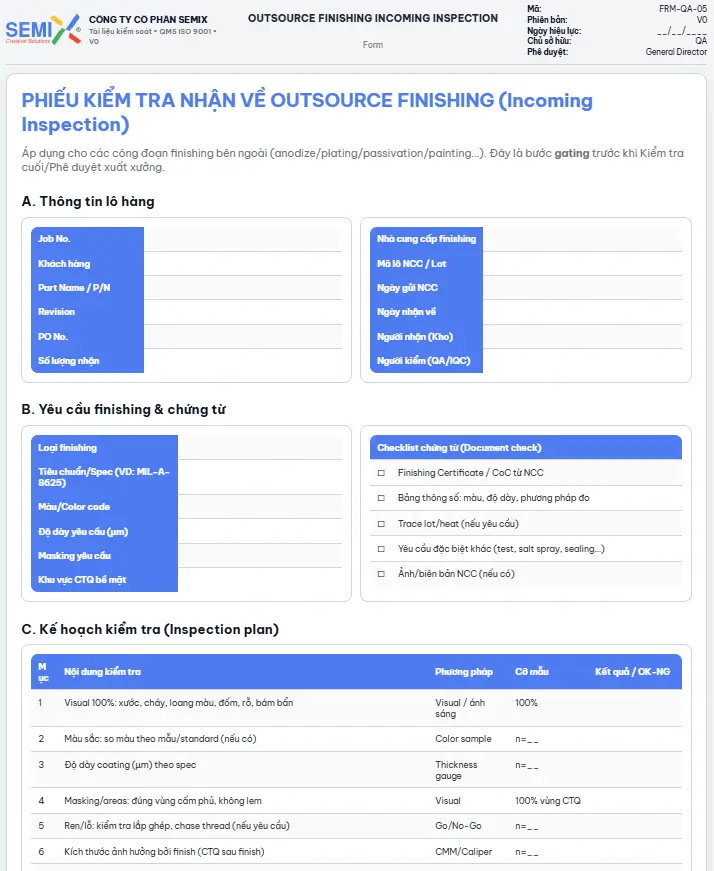
The checklist
This checklist is designed for engineering, procurement, and supplier quality. You can copy/paste it into your RFQ or supplier qualification document.
1) RFQ clarity (before quoting)
- Drawing + model with revision level (PDF + STEP/IGES)
- Material grade/condition + required certificates (if any)
- Finish type, thickness, masking zones, cosmetic requirements
- CTQs: the features you want measured and reported
- Quantity, schedule, and whether it is prototype / pilot / production
- Documentation package requirements (CoC, MTR, inspection report, first article)
2) Contract review (before cutting metal)
- Written assumptions for deburr / edge break and datum strategy
- Inspection plan agreed: measurement method + reporting format
- Finish boundaries confirmed and acceptance criteria stated
- Nonconformance handling path defined (notify, disposition, corrective action)
3) Build execution (during machining)
- Routing reduces setups where possible (4/5‑axis when it improves repeatability)
- Tool wear and process controls monitored for repeat runs
- Critical surfaces protected throughout handling
4) Inspection + documentation (before shipment)
- CTQ inspection report completed and reviewed
- CoC and certificates assembled in a single package
- Labels include PO line, part number, revision, and quantity (as required)
5) Packaging + logistics (shipment readiness)
- Protective packaging prevents transit damage and keeps surfaces clean
- Kitting/labeling aligns to your receiving and line-side workflow
- Shipping method aligned to schedule (air vs ocean) and risk tolerance
Where lead time usually slips
Most lead time slips happen in predictable places. If you control these, outsourcing becomes far more stable.
| Where it slips | Why | Fix |
|---|---|---|
| Finishing | External queue times, masking mistakes, rework | Define finish boundaries + acceptance criteria early |
| Inspection | CTQs unclear, measurement method not planned | Agree inspection plan at contract review |
| Revision changes | Mid-build drawing changes without change control | Revision control and explicit approval checkpoints |
| Packaging | Damage in transit or labeling confusion | Packaging spec + labeling rules |
This is why SEMIX emphasizes documentation and inspection scope—because it directly impacts schedule, not just “quality.”
FAQ
Should we request CTQ inspection on every dimension?
No. Request CTQ inspection on the dimensions/features that impact function, assembly, or risk. Measuring everything can slow lead time and increase cost without improving outcomes.
What is the best way to prevent revision confusion?
Always reference drawing revision and model revision on quotes and POs, and require a written confirmation when revisions change.
Does documentation really affect lead time?
Yes. If documentation is incomplete, receiving can stop the line even if parts are good. Building documentation into the plan prevents this.
How does 5-axis affect lead time?
5-axis can reduce setups and rework risk for complex parts, which often improves predictability. It is not always faster for simple parts.
Can SEMIX help us implement this checklist?
Yes. We can align quoting, inspection scope, and documentation packages to your program needs.