
Risk hubs • Thermal

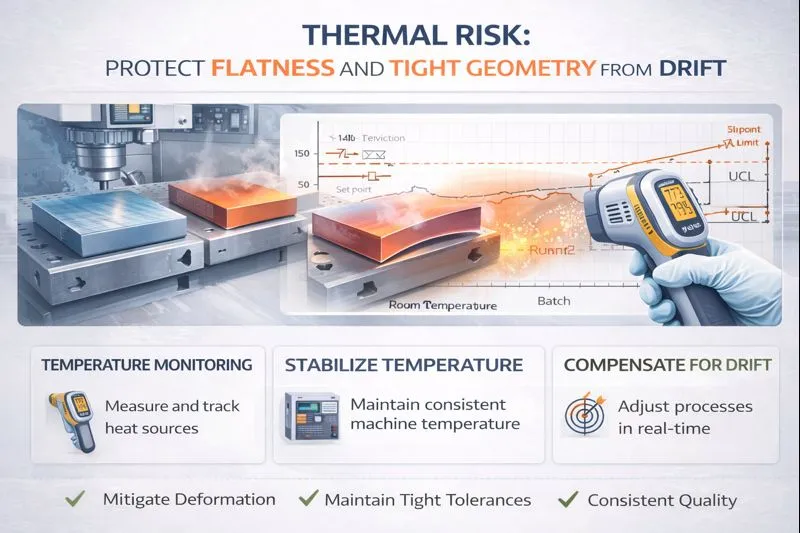
Thermal risk: protect flatness and tight geometry from drift

Thermal state changes size. This hub covers warm‑up, soak, measurement temperature, and acceptance decisions so CTQs stay stable from inspection to receiving.

Thermal
Buyer‑ready evidence Dispute prevention Repeatable controls Export‑ready delivery
Thermal risk hub
SEMIX — evidence-driven CNC machining in Vietnam.

What to watch for (failure modes) vs. what to request (controls)

Common failure modes

  • Geometry shifts between machining and inspection due to warm-up or restart drift.
  • Supplier measures at one thermal state; customer measures at another (flatness disputes).
  • Residual stress releases after roughing/finishing, warping parts post-process.
  • Inspection performed before the part reaches thermal equilibrium.

Controls & evidence you should ask for

  • Warm-up and restart rules (ISO 230‑3 concepts) to stabilize machine thermal behavior.
  • Inspection timing guidance (when to measure; soak time for part + fixture).
  • Process sequencing that reduces distortion risk (rough/finish strategy + stress relief gates when needed).
  • Reporting notes that declare thermal state assumptions for CTQ measurements.
  • Evidence patterns for thermal-state disputes and corrective-action logic.

RFQ snippet (copy/paste)

Use the lines below to make sure your RFQ/PO includes the evidence needed to eliminate this risk.

  • Call out thermal-sensitive CTQs (flatness, true position over long spans, sealing faces).
  • Specify inspection environment requirements (temperature range, soak time, stabilization expectations).
  • If you’ve had past disputes, share failure symptoms so we align the decision rule and method early.

RFQ checklist Start an RFQ Evidence pack starter kit

Fast path

If you only do one thing: align the CTQs + decision rule + evidence pack format before first article. Most receiving disputes come from ambiguity, not capability.

Documentation packages Inspection & metrology

Proof library (projects + evidence patterns + briefs)

Use these links to evaluate capability and corrective-action maturity before placing a PO.

Related projects

View all projects in this theme

Evidence patterns (incident-style case studies)

Browse all evidence patterns

Deep technical briefs

View all briefs in this theme Technical academy

Templates & evidence pack artifacts

If your receiving team uses specific forms, share them during RFQ—SEMIX can map fields 1:1. Otherwise, start with the templates below.

Browse all templates Request a Quote

Why templates matter

In global supply chains, “quality” is often judged at receiving. A clean evidence pack reduces back‑and‑forth, speeds approvals, and protects schedules.

These templates are print‑to‑PDF and designed to be adapted to your PO flow‑downs.

FAQ

Why do flatness disputes happen between supplier and customer?

Often because the part is measured at different thermal states or without an uncertainty-aware decision rule. This hub links to evidence patterns that show how to prevent that.

Do you control warm-up and restart behavior?

Yes. For thermal-sensitive work we use warm-up routines, restart checks, and inspection timing rules so results are stable.

Can you document thermal assumptions in reports?

Yes. We can include notes on inspection conditions and stabilization expectations in the evidence pack.

Ready to reduce this risk?

Send an RFQ package (NDA first if needed) with your drawing/model, material/finish, quantity, CTQs, and evidence requirements.

Request a Quote Browse projects Browse risk hubs

Request a QuoteEvidence pack