
Executive takeaway
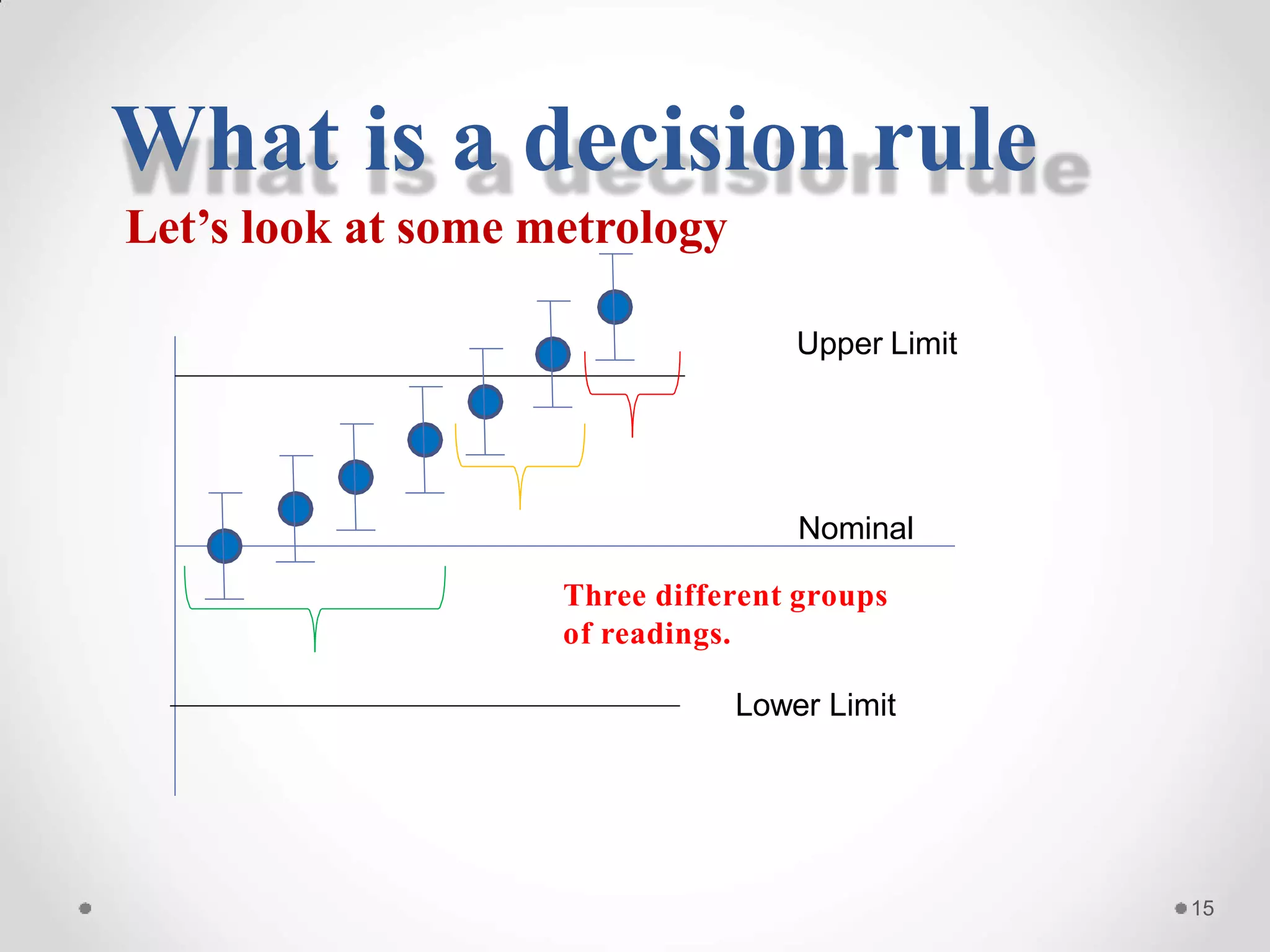
If a measured value is close to a specification limit, a simple “PASS/FAIL” without an agreed decision rule is not engineering—it is gambling.
A buyer-grade inspection system requires:
- a defined decision rule
- an understanding of measurement uncertainty
- a clear statement of conformity
GUM: what uncertainty is (in practical language)
GUM frames uncertainty as the dispersion of values that could reasonably be attributed to the measurand.
In production terms:
- Uncertainty tells you how confident you are that the real value is within tolerance.
- Without it, “pass” is not a risk statement.
ISO 14253‑1: why it exists
ISO 14253‑1 provides decision rules for proving conformity or nonconformity when measurement uncertainty exists.
This is critical when:
- tolerances are tight,
- different measurement systems are used (supplier vs customer),
- form and datum simulation choices influence results.
ILAC G8: what buyers expect from serious reporting
ILAC G8 guides decision rules and statements of conformity (aligned to ISO/IEC 17025 practice).
Even if you are not a calibration lab, using ILAC-style clarity reduces disputes:
- declare the rule
- declare what “pass” means
- declare what happens in the guard band
Guard bands: the simplest practical tool
A guard band shifts acceptance limits inward to reduce false acceptance risk.
Example (conceptual):
- If the spec is near the measured value and uncertainty is significant,
accepting only when the measured value is safely inside the limit reduces buyer risk.
Trade-off:
- fewer false accepts (good for customer)
- more false rejects (cost to supplier)
The correct rule depends on contract, risk class, and buyer requirements.
How to implement in a CNC factory (without bureaucracy)
- Identify CTQ characteristics (tight tolerance, functional, safety-critical)
- For each CTQ, define:
- measurement method
- uncertainty level (even simplified)
- decision rule
- Put the decision rule on:
- the traveler
- the inspection report
- When customer uses a different method, run a correlation study and align rules.
Dispute-proof report structure
A robust report includes:
- drawing revision and characteristic ID
- measurement method and conditions (temperature, stabilization)
- measured value
- declared uncertainty (or a method capability statement)
- decision rule and result statement (PASS/FAIL/conditional)
Buyer evidence pack
- Decision rule policy for CTQ dimensions
- Example statement-of-conformity template
- Correlation study approach for customer measurement alignment
FAQ for buyers
- Why do parts pass at the supplier but fail at the customer?
- What is a guard band and when should it be used?
- How do you agree decision rules during RFQ to avoid disputes?
- What does “statement of conformity” mean in inspection reports?