
Preview sample formats for CoC, CTQ inspection reports, and packaging checklists.
ISO 9001 QMS • Inspection evidence • Export-ready delivery
Materials
Common CNC materials sourced and machined in Vietnam—aluminum, stainless, tool steel, titanium, and engineered polymers—selected for function, finish, and lead time.
Precision machining
5-axis capable
Inspection reports
Export-ready packaging
Proof
Evidence you can request at RFQ
Material choice affects stability, finishing, and traceability. Ask for documentation formats (MTR mapping) and thermal/measurement considerations.
Overview
Material selection: start with function, then optimize for manufacturability
For global programs, the “right” material is not only about strength. It is also about corrosion resistance, thermal behavior, cleanliness needs, finish compatibility, and total cost of ownership.
To quote accurately and avoid lead-time surprises, provide the exact material specification (grade, temper/condition, and any heat treatment requirements). If the spec is flexible, we can recommend options that reduce cost or improve machining stability.
Common materials we machine
Metals and engineering plastics
| Material family | Common examples | Typical uses | Machining notes |
|---|---|---|---|
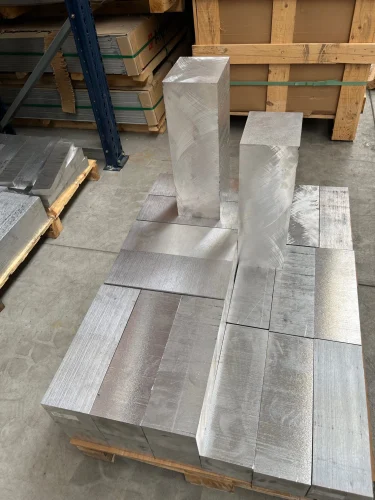
| Aluminum | 6061-T6, 7075, 5052 | Housings, plates, brackets, fixtures, aerospace and semiconductor hardware | Great machinability; supports anodizing; watch thin walls and distortion on large plates |
| Stainless steel | 303, 304, 316 | Corrosion-resistant parts, medical tooling, industrial hardware | Work-hardening risk; tool strategy and coolant control matter for surface finish |
| Carbon & alloy steel | 1045, 4140 (spec-dependent) | Shafts, structural parts, machine components | May require heat treatment; plan for dimensional change and final machining allowances |
| Tool steels | D2, SKD11 (spec-dependent) | Production tooling, dies, wear components | Hardness impacts machining route (rough → heat treat → finish grind/machine) |
| Titanium | Ti-6Al-4V (spec-dependent) | High strength-to-weight aerospace/medical applications | Heat management and tool selection are critical; machining strategy affects cost |
| Copper & brass | C110, C360 (spec-dependent) | Electrical components, connectors, thermal hardware | Soft materials require burr control and careful surface protection |
| Engineering plastics | POM/Delrin, PEEK, PTFE, Nylon | Insulators, wear components, fixtures, semiconductor tooling | Thermal expansion; avoid sharp internal corners; plan for stable clamping |
Material certificates
Traceability and documentation
For many international customers, material traceability is part of supplier qualification. If your program requires it, SEMIX can support material certificates (MTRs) and documentation packages aligned to your PO flow-down.
- Specify certificate needs in RFQ (MTR, CoC, finishing certificates, first-article package).
- Define revision and spec references so documents align to the correct requirement set.
- Clarify marking/labeling requirements if traceability must be preserved through kitting.
FAQ
Material & finishing questions
Can you recommend alternative materials to reduce cost?
Yes. If the drawing allows material flexibility, we can propose alternatives that improve machinability or shorten lead time—while maintaining functional requirements.
Do you support anodizing, passivation, plating, or painting?
We coordinate common finishing processes based on requirements. Specify the standard, color, thickness, and any masking needs in the RFQ stage. See Finishing & Logistics.
Can you machine engineering plastics for semiconductor tooling?
Yes. Engineering plastics are common in tooling and fixtures. Share spec, environment requirements, and CTQs to plan clamping and dimensional control.