
Preview sample formats for CoC, CTQ inspection reports, and packaging checklists.
ISO 9001 QMS • Inspection evidence • Export-ready delivery
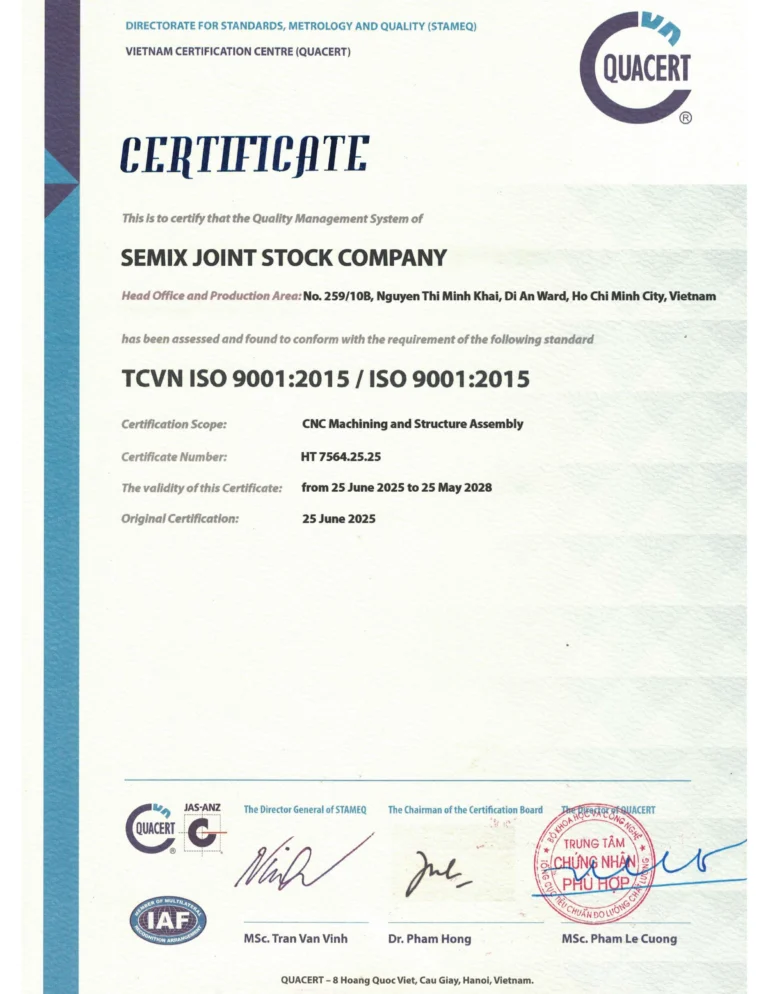
ISO 9001 Quality Management System (QMS)
How our ISO 9001 system is applied in machining: document control, contract review, calibration management, nonconformance control, and corrective action—so approvals and audits are straightforward.
Precision machining
5-axis capable
Inspection reports
Export-ready packaging
Proof
Evidence you can request at RFQ
ISO 9001 is meaningful when it drives revision control, traceability, and consistent evidence. Use these examples as a qualification checklist.
What ISO 9001 means for buyers
A predictable system that reduces risk
ISO 9001 is an internationally recognized quality management system standard. In a machining environment, it supports consistent execution, continual improvement, and risk‑based thinking across the workflow.
For buyers, the practical benefits are:
- Consistent outputs from repeatable processes rather than “operator heroics.”
- Documented control of revisions, procedures, and records.
- Corrective action and learning loops when issues occur.
- Supplier and material control aligned to requirements.
How SEMIX applies QMS to machining
QMS mapped to the CNC machining lifecycle
We confirm drawing revision, CTQs, material/finish, quantity, schedule expectations, required documents, and packaging requirements before production release.
Datums, setup plan, fixturing, tool strategy, inspection checkpoints, and risk review are defined before cutting metal.
Programs and work instructions are controlled; in‑process checks are performed on critical features to prevent drift.
Metrology methods are selected to match CTQs and reporting needs, including dimensional reports and certificates as required.
Clear segregation and disposition steps protect customers from receiving nonconforming product.
Root cause, corrective action, and preventive actions strengthen the system over time.
Calibration & traceability
Measurement confidence and controlled records
Precision machining requires measurement confidence. SEMIX maintains calibration control for measurement tools and supports traceable records aligned to customer requirements.
- Calibrated measurement tools used based on required uncertainty and feature type.
- CMM probe qualification gates for CTQ measurement (shift gating, tool grading, post‑collision re‑qualification). See an example.
- Record keeping that links inspection results to the correct revision and PO/lot.
- Continuous improvement based on inspection data and process feedback.
Nonconformance & CAPA
Containment and corrective action that protect receiving
Export programs are judged at receiving. SEMIX runs documented containment, MRB disposition, and CAPA discipline so issues are handled fast—and prevented from repeating.
- HOLD segregation so nonconforming product cannot silently ship.
- Disposition control (rework/repair/scrap/return) with concessions only by buyer approval.
- 8D/CAPA when needed: root cause, corrective action, and effectiveness verification.
FAQ
ISO 9001 & supplier qualification questions
Can you share your ISO certificate?
Yes. We can provide certification information and supporting documentation as appropriate for supplier qualification. See our Quality overview and provide your requirements via RFQ.
Do you support audits or supplier assessments?
We can support supplier qualification discussions and provide process explanations, evidence samples, and documentation outlines depending on program sensitivity and NDA status.
How do you ensure the correct drawing revision is used?
Revision level is confirmed during contract review. Controlled release of production data and records helps ensure the shop floor uses the approved revision set.
Leadership, facility, and metrology
These pages strengthen buyer trust signals (E‑E‑A‑T) and help procurement teams qualify SEMIX as a Vietnam CNC machining supplier.
Clear ownership for engineering, quality, and delivery decisions across global programs.
Location context, audit readiness, export-ready operations, and what buyers can request.
CTQ measurement planning and reporting that reduces receiving friction.
How we manage document control, nonconformance, and corrective actions.
CoC, MTR (as required), inspection reports, and first-article support.
Anonymized evidence showing workflow by industry.