
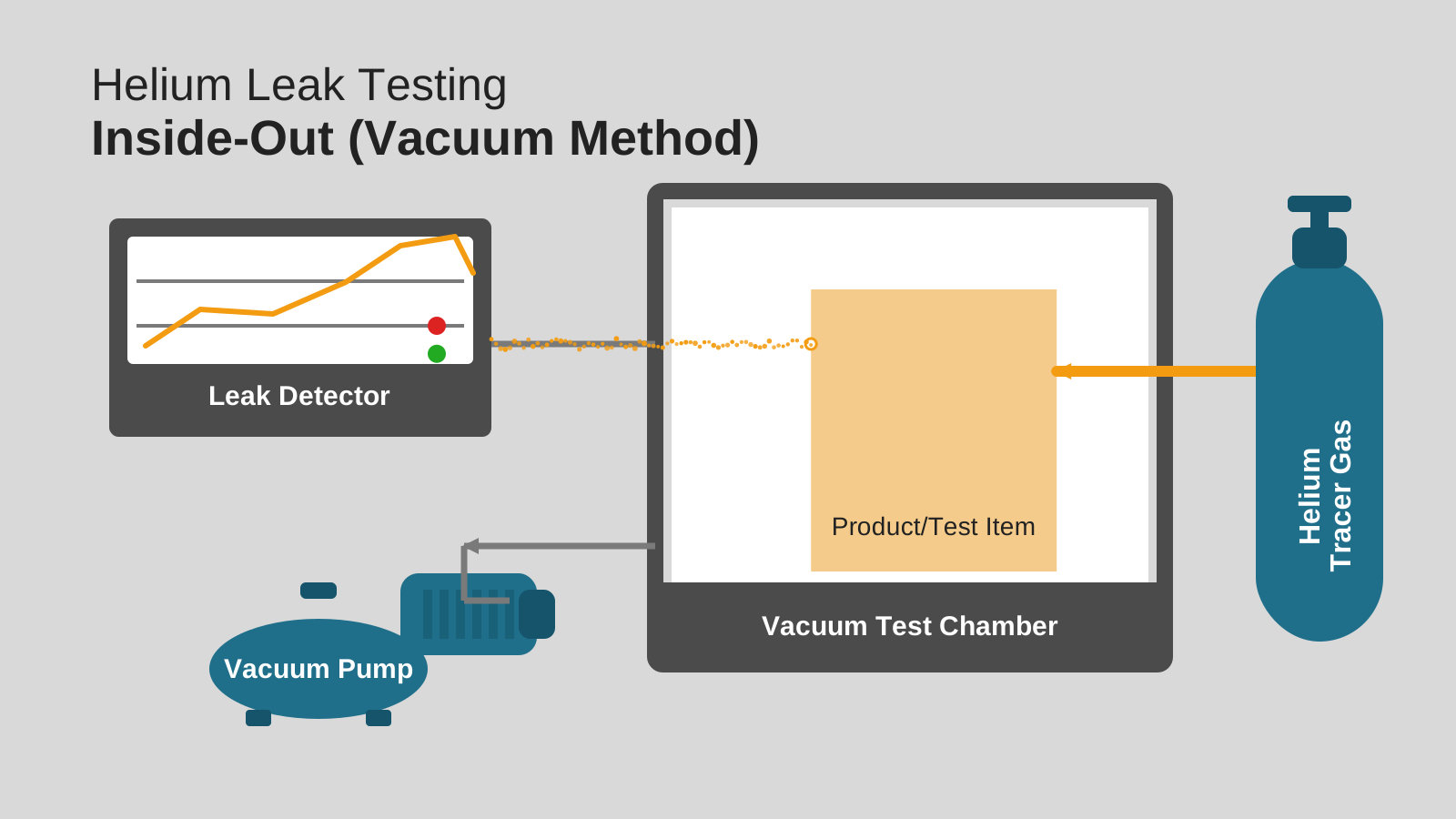
Executive takeaway
Most leak-test disputes are not about the part—they are about:
- background helium,
- fixture leakage,
- stabilization time,
- and inconsistent decision rules.
A robust leak-testing program treats leak test as metrology, not “a quick check.”
Standards anchor your method language
ISO 20485 describes tracer gas leak testing techniques using tracer-gas specific detectors. ASTM E499 provides practice guidance for mass spectrometer leak testing (including probe methods).
These references help you define:
- method type (integral vs local/probe)
- calibration checks
- reporting format
Failure modes that cause false fails
- Fixture micro-leaks dominate the signal
- Helium background accumulates in the test area
- Contaminated seals create temporary leaks
- Insufficient purge/dwell time
- Operator timing variation
Designing a production-grade test (step-by-step)
- Baseline the fixture (blank test): quantify background level
- Verify calibration using a standard leak at start and end
- Define stabilization time (repeatable dwell) before reading
- Control handling: clean gloves, controlled surfaces
- Document the method so customer can reproduce or correlate
Decision rules near threshold
If the reading is near the limit:
- declare re-test logic (how many repeats, what conditions)
- declare what constitutes “pass”
- align with a conformity decision rule policy for critical programs
Control plan
- Fixture maintenance schedule
- Background monitoring log
- Standard leak verification policy
- Retest protocol and containment workflow
Buyer evidence pack
- Leak test method statement (mode, calibration, dwell, background control)
- Fixture baseline records
- Sample reports with clear pass/fail and conditions
FAQ for buyers
- Why does the same part pass at supplier but fail at customer?
- What is the difference between localization and integral leak tests?
- How do you manage helium background in production?
- What does a dispute-proof leak test report include?