
We confirmed which features drive assembly fit and which tolerances are “nice-to-have.” This shaped both fixturing and inspection scope.
Case study • CTQ evidence • Export-ready delivery
Case Study: 5‑Axis Complex Bracket (Setup Reduction)
An anonymized example showing how SEMIX uses 5‑axis machining in Vietnam to reduce setups, protect relational accuracy, and deliver receiving-ready evidence for international programs.
Program snapshot
Customer: International engineering team (U.S.-led program, customer name withheld)
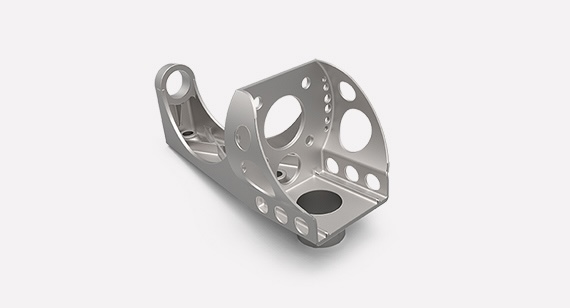
Part: Structural bracket with multiple angled faces, features on several planes, and tight positional relationships
Primary risks: too many setups causing stack-up error; surface finish and tool access limitations
| Driver | Buyer need | SEMIX response |
|---|---|---|
| Relationship accuracy | Angled hole patterns and interface planes must align | 5‑axis simultaneous strategy to reduce re‑clamping |
| Surface finish | Cosmetic and functional surfaces need consistent finish | Tool orientation control to improve finish and reduce tool marks |
| Lead time | Prototype timing affects downstream build schedule | Single-route planning + early risk clarification during RFQ |
| Field | Details (public) |
|---|---|
| Material / finish | Anonymized (share under NDA if needed) |
| Size envelope | Anonymized (available under NDA) |
| Qty range | Prototype / NPI (anonymized) |
| CTQ focus | Datums + functional features (CTQs defined at RFQ) |
| Tolerance & verification | Tight/critical features verified on CTQ-focused report (ranges shared under NDA) |
| Lead time | Quoted per RFQ; schedule aligned to customer gate dates (ranges under NDA) |
| Evidence pack | CTQ report • CoC • material/finish certs (as applicable) • packaging notes |
Challenge
The bracket had features distributed across multiple planes, including angled holes and pockets. A 3‑axis approach would require multiple setups, increasing the risk of positional drift and adding lead time.
- Setup stack-up: each re-clamp adds potential error between planes
- Tool access: deep pockets and angled faces limit tool reach and stability
- Finish consistency: visible faces need controlled tool orientation to avoid marks
- Quote assumptions: unclear CTQs can cause mismatched inspection expectations
Approach
SEMIX planned the job around the buyer’s functional relationships. We used 5‑axis to reduce setups and to maintain tool orientation for better finish and stable geometry.
We evaluated whether indexed 5‑axis or simultaneous 5‑axis best protected CTQs while keeping cycle time practical.
Critical features were machined with minimal re‑clamping to reduce stack‑up. Fewer setups also improved throughput for repeat lots.
Tool orientation was managed to improve finish consistency, and deburr expectations were aligned for receiving and assembly needs.
Buyer resource: 5‑axis machining in Vietnam guide.
Inspection and evidence delivered
The buyer required evidence for key relationships rather than a costly “inspect everything” approach. SEMIX delivered a CTQ-focused dimensional report aligned to the functional features.
- CTQ dimensional report mapped to datums and interface features
- Certificate of Conformance linked to revision and PO
- Packaging aligned to protect cosmetic and interface surfaces
Evidence pack preview (redacted)
On request, we can share redacted examples of the exact report formats our U.S. buyers receive—so your receiving team knows what to expect.
Redacted layout showing CTQ callouts, datums, and how pass/fail is stated.
Revision- and PO-linked CoC format used for receiving acceptance.
Redacted packaging notes for protection, labeling, and kitted shipments (if applicable).
See: Inspection & metrology and Documentation packages.
When 5‑axis is the right choice
Many buyers associate 5‑axis machining with “more expensive,” but for complex brackets it can reduce total landed cost by eliminating setups, reducing inspection burden, and preventing rework from stack-up error. In this program, 5‑axis was chosen because the part had multiple angled features that needed strong relational control.
- Best-fit cases: angled holes, compound surfaces, multi-plane interfaces, or deep pockets where tool access matters
- Value drivers: fewer setups, better finish, less rework, faster validation cycles
- Buyer decision tip: compare total cost (setup + inspection + risk), not only cycle time
Guide: 5‑axis machining in Vietnam.
DFM notes that improved manufacturability
During RFQ review, SEMIX flagged a small set of manufacturability risks that commonly affect complex brackets. These notes help buyers avoid delays and get more consistent parts:
CTQs were separated from non-critical features to keep inspection efficient and avoid unnecessary cost.
Minimum corner radii and tool reach limits were reviewed to reduce chatter and improve finish on deep pockets.
“Break edges” expectations were clarified so finishing time is predictable and consistent across lots.
Packaging requirements were aligned early to protect cosmetic faces in export transit and receiving.
DFM resource: DFM checklist.
RFQ checklist for complex 5‑axis brackets
If you have a similar part, your RFQ will move faster when the following are clearly defined: functional datums, CTQs, finish requirements, and inspection expectations. For export programs, also include packaging and labeling rules to avoid last‑minute changes.
Outcome
The 5‑axis approach reduced setup-driven risk and delivered the bracket with receiving-ready evidence. For buyers, the biggest win was predictable relational accuracy—critical for assembly fit and schedule confidence.
Outcome highlights
Evidence formatted for receiving review; CTQs highlighted to reduce back-and-forth.
CTQ inspection plan executed; CoC and required certs packaged with the shipment.
Delivery and documentation aligned to the customer’s internal gate / PO flow-down.
Takeaway for U.S. buyers
If a part spans multiple planes with angled features, ask suppliers how many setups are required and which CTQs are protected in single-clamp operations. Setup count is a strong proxy for risk and lead time.
Deep dive (technical briefs)
If you want the engineering rationale behind the controls used in this program, start with these related briefs from our Technical Academy:
-
ISO 230‑7 Rotary Axis Accuracy | 5‑Axis Error Mapping & Proof
How ISO 230‑7 rotary axis accuracy relates to 5-axis part errors, and how to qualify 5-axis trustworthiness using orientation sweeps, error mapping logic, and buyer-ready evidence packages.
Read the full brief
-
ISO 230‑2 / ISO 230‑4 CNC Accuracy Tests | Part‑Level Risk Control
How to use ISO 230‑2 positioning tests and ISO 230‑4 circular/contouring tests to manage tolerance risk, schedule verification, and prove CNC capability to U.S./EU buyers sourcing CNC machining in Vietnam.
Read the full brief
-
Tool Wear & Tool Life Engineering in CNC Machining | Taylor + ISO 3685 + Monitoring
A deep, production-focused guide to wear mechanisms, defensible tool-life testing, responsible use of the Taylor equation, and practical tool-condition monitoring that reduces scrap and unplanned downtime.
Read the full brief
-
Short‑Run SPC for High‑Mix CNC | EWMA & CUSUM Drift Detection
Applied EWMA and CUSUM control for high-mix machining: standardizing CTQs, setting limits, detecting small shifts early, and implementing practical reaction plans for CNC machining suppliers.
Read the full brief
Evidence patterns (technical case studies)
Incident-style write-ups that show how SEMIX handles common failure modes and prevents receiving disputes:
-
Case Study (Aerospace 5‑Axis): Orientation‑Dependent True Position Failure | ISO 230‑7 Logic
True position failed only at certain tilts. Root cause traced to rotary-axis geometry error and post/kinematic mismatch. Fix used ISO 230‑7 style verification and orientation sweeps.
Read the case
-
Case Study (Aerospace): Late‑Batch Reject Spike | Wear‑Driven Regime Change
Rejects appeared late in the batch. Root cause was wear-driven cutting regime change shrinking stability margins. Fix used wear gating plus EWMA/CUSUM drift detection.
Read the case
Documentation templates (print-to-PDF)
Want consistent receiving-ready evidence? These templates show typical formats SEMIX can provide with shipments (redacted samples available under NDA):
-
Certificate of Conformance (CoC) template
Buyer-friendly CoC with clear scope, drawing revision reference, and statement of conformity.
Open template
-
Inspection plan (CTQ) template
Characteristic table with method, sampling, decision rules, and reaction plans—built for high-trust programs.
Open template
-
Final inspection report template
A report structure that reduces disputes: conditions, CTQ highlights, and declared decision rules.
Open template
-
Packaging & shipping checklist template
Packaging spec, label control, photos, and shipment signoff for export-ready delivery.
Open template