
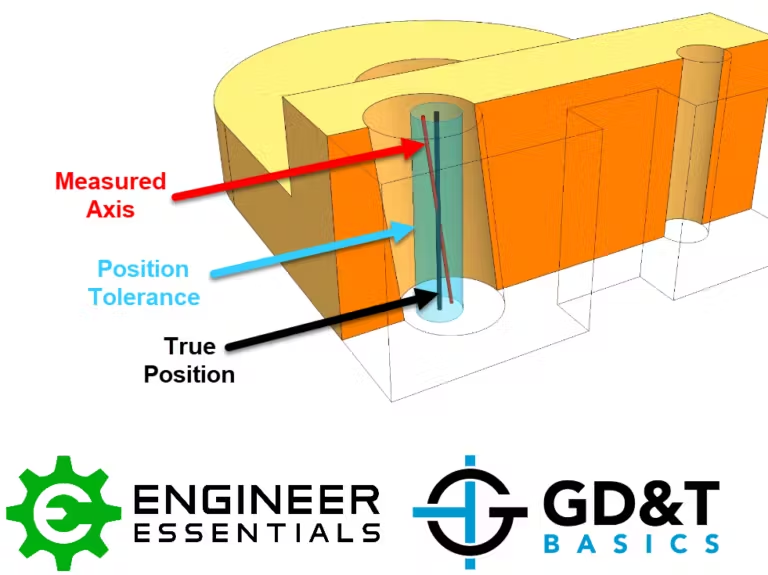
Symptom
A part family showed:
- true position passing at 0° orientation
- true position failing at 20–40° tilt angles
- no obvious tool wear or fixturing change
Mechanism
In 5-axis, TCP error depends on rotary-axis geometry and kinematic modeling. Small rotary pivot or axis error motion creates tool tip shifts that change with angle.
Amplifiers:
- long tool gauge length
- large tilt angles
- tight positional tolerances
Investigation
- Run an orientation sweep: measure the same feature across multiple rotary angles.
- Compare deviation vs angle to identify systematic orientation dependency.
- Audit postprocessor revision and kinematic configuration.
- Verify tool assembly definition (gauge length consistency).
Root cause
- Rotary-axis geometric behavior was not aligned with the kinematic model used in programming.
- Orientation-dependent error was not detected by 0° qualification alone.
Corrective actions
- ISO 230‑7 style rotary verification logic
- Orientation sweep qualification as a release gate for CTQ 5-axis families
- Postprocessor revision control and validation artifact
- Tool assembly locking for CTQ programs
Evidence and outcomes
- Deviation vs angle charts improved after correction
- Reduced orientation-dependent failures
- Stronger buyer confidence through documented kinematic control
FAQ for buyers
- What causes orientation-dependent failures in 5-axis machining?
- How do you verify rotary axes beyond probing one angle?
- What controls ensure postprocessor changes don’t create escapes?