
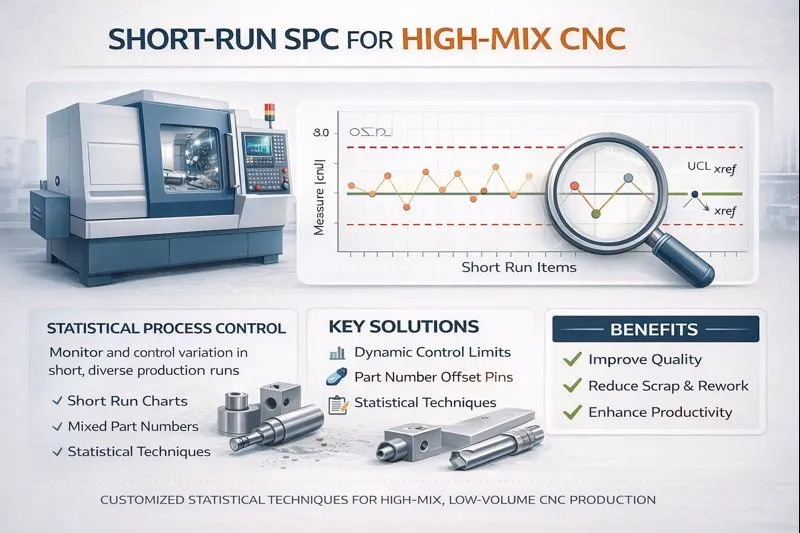
Executive takeaway
Traditional SPC charts often fail in high-mix machining because:
- lot sizes are small,
- setups change frequently,
- and drift sources (thermal, wear, fixturing) are time-dependent.
EWMA and CUSUM are valuable because they detect smaller shifts earlier, even with limited data—when implemented with disciplined standardization.
Why Shewhart charts underperform in CNC job shops
- Re-clamping and setup changes create multi-modal distributions
- Tool wear creates slow mean drift (not sudden jumps)
- Thermal transients create non-stationary behavior
If you chart everything the same way, you will either:
- trigger too many false alarms, or
- miss the drift until parts fail.
EWMA: practical use in machining
EWMA weights recent measurements more than older ones, making it sensitive to gradual drift. Implementation pattern:
- Choose one sentinel CTQ per setup (most wear/thermal sensitive)
- Compute EWMA on that feature
- Trigger investigation when EWMA crosses limits
What it catches well:
- tool wear drift
- thermal drift during long runs
- gradual fixture slip
CUSUM: practical use in machining
CUSUM accumulates deviations from target to detect small persistent shifts. Implementation pattern:
- Use for CTQs where small shifts matter (micron-class)
- Use consistent measurement method
- Tie triggers to a structured root-cause workflow
How to make short-run SPC work (the missing discipline)
Standardize CTQs across different parts
For high mix, convert CTQs to a standardized score:
- Z-score based on nominal and tolerance width
This allows you to chart “process health” even across part numbers.
Lock the measurement process
If measurement changes, the chart becomes meaningless.
- same datum simulation
- same CMM program
- same temperature discipline
Define reaction plans by failure mode class
When the chart triggers, do not “adjust offsets blindly.” Use a structured check:
- thermal state (warm-up / restart)
- tool wear and edge condition
- fixturing stability and seating
- coolant cleanliness / temperature
- program changes and compensation state
Buyer evidence pack
- SPC method statement for high-mix environments
- Examples of drift detection and corrective action before escape
- Reaction plan and containment logic
FAQ for buyers
- How do you do SPC with lot sizes of 5–20?
- Why are EWMA and CUSUM better for slow drift?
- What happens when SPC indicates drift—do you stop the run?
- How do you prevent SPC from becoming “paperwork only”?