
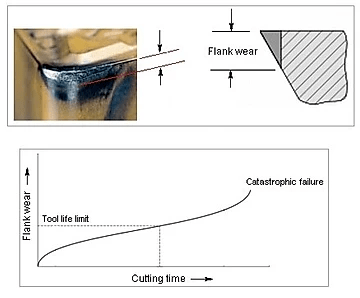
Problem statement
Aerospace parts were stable early in the batch, then rejection rate increased sharply later. The program did not change, material certs were consistent, and operators followed the traveler.
Mechanism chain (why this happens)
Tool wear causes a progressive regime change:
- cutting forces increase (ploughing replaces shearing near the edge)
- heat generation increases
- deflection increases
- stability margin decreases (higher chatter susceptibility)
- size and surface quality drift, sometimes accelerating near end of tool life
This is not random. It is time-dependent physics.
Investigation approach
- Identify the first feature that drifted (sentinel characteristic).
- Compare early vs late batch measurements and surface signatures.
- Review tool life window: time in cut, edge condition, and wear pattern.
- Check thermal state and coolant condition for compounding effects.
Root cause
Wear-driven regime change reduced the process window:
- size drift increased
- surface quality degraded
- stability margin decreased, increasing micro-chatter and variability
Corrective action system
Wear gating (not just “change after N parts”)
- Establish a maximum tool life window for CTQ surfaces.
- Include intermediate checks tied to drift indicators, not only part count.
Drift detection using short-run SPC
- Track a sentinel CTQ with EWMA or CUSUM style logic.
- Trigger tool change and verification before parts go out-of-spec.
Reaction plan
- when drift triggers: stop, verify thermal state, inspect tool, change tool, run verification cut, contain WIP.
Evidence produced
- Trend charts showing drift detection before rejects
- Updated control plan linking tool life and measurement gates
- Reduced late-batch rejection and more stable capability
FAQ for buyers
- Why do rejects spike late in a batch if the program didn’t change?
- How do you control tool wear for high-assurance aerospace work?
- What SPC evidence should a supplier provide for drift control?