
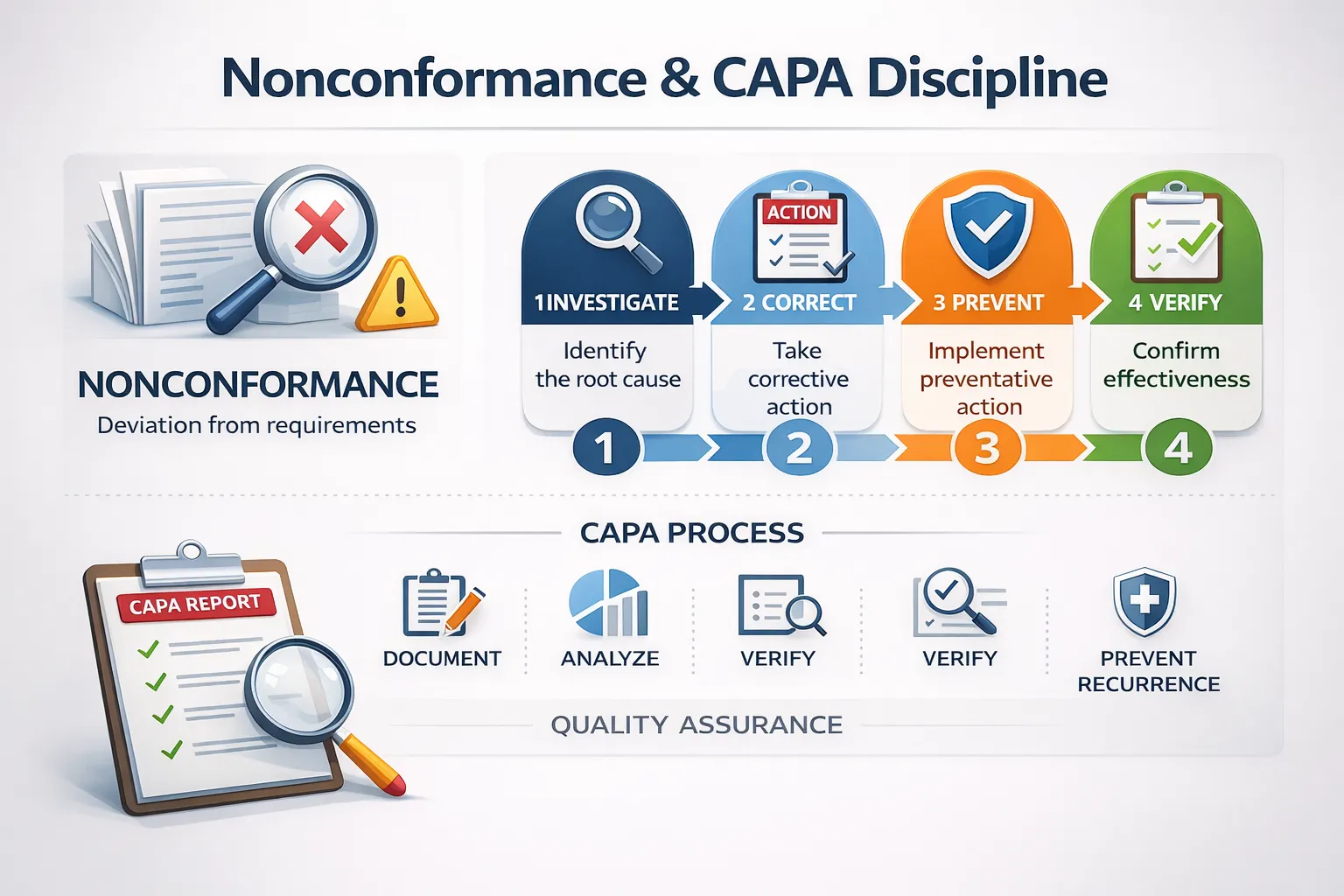
Executive takeaway
- Containment is first: HOLD tagging + physical segregation prevents escapes while facts are collected.
- Disposition is controlled: MRB decides rework/repair/scrap/return; concessions ship only with written buyer approval.
- CAPA is not a document: corrective action is a control‑plan change (process + tooling + measurement + data), verified with follow‑up evidence.
- Buyers receive clear outputs: NCR summary, containment actions, re‑inspection evidence, and 8D/CAPA when required.
Nonconformance control: default is HOLD
When an issue is detected (incoming, in‑process, final inspection, or during packing), SEMIX treats the product as nonconforming until it is formally dispositioned. “Quick fixes” that return parts to OK flow without documentation are banned because they create silent escapes.
- Segregate: affected parts are physically separated from OK flow and tagged HOLD/NG.
- Stop the bleed: confirm whether the issue is isolated or systemic (one part vs the lot vs the process).
- Capture evidence: photos, measurements, and lot context are recorded while the condition is fresh.
- Protect the customer: shipment is blocked until disposition and verification are complete.
Disposition (MRB): how product is released safely
Disposition is an engineering and risk decision. SEMIX uses an MRB approach to choose the correct disposition based on function, safety, downstream impact, and contractual requirements.
| Disposition | What it means | Controls required |
|---|---|---|
| Rework | Bring the part fully back to requirement | Defined method + re‑inspection evidence on affected CTQs |
| Repair | Engineering-approved deviation that restores function | Approval + documentation and clear marking/traceability as required |
| Scrap | Remove product from the supply chain | Physical segregation + record update |
| Return to supplier | Nonconformance originated in purchased material/process | Supplier containment and corrective action request (SCAR) if needed |
| Concession / use‑as‑is | Ship with a known deviation | Written buyer approval before shipment; scope and marking defined |
When CAPA / 8D is mandatory
Not every NCR needs a full CAPA. CAPA is opened when risk and recurrence justify it. Typical triggers:
- Major nonconformance (functional / safety / high-cost impact).
- Repeat issues (same failure mechanism recurring across lots or time).
- Customer complaint or receiving rejection.
- Safety / legal risk or compliance-sensitive programs.
- Significant delivery impact where a systemic fix is required to protect schedule.
Root cause by mechanism (not by blame)
Root cause analysis is only useful when it points to a mechanism that can be controlled. SEMIX uses data-driven logic (5‑Why + Fishbone across Man/Machine/Method/Material/Measurement/Environment) and verifies causes against evidence.
Common CNC failure mechanisms (examples)
- Tool wear / regime change: late-batch drift or sudden stability loss. See a wear-driven reject case study.
- Fixturing / datum shift: clamp distortion, inconsistent seating, or datum misinterpretation.
- Thermal state mismatch: “hot” vs “cold” measurement differences near limit. See a thermal + decision rule case study.
- Measurement system faults: unqualified probes, uncontrolled gages, or method mismatch. Calibration & traceability controls.
- Cleanliness/packaging latency: burr/particle escapes that show up after transit. See a packaging/particle case study.
Corrective action that prevents recurrence
“Retrain the operator” is not a corrective action. Corrective action is a control upgrade that makes the failure mode hard to repeat. SEMIX corrective actions typically cover multiple layers:
- Process: update route gates, inspection checkpoints, reaction plans, and acceptance criteria.
- People: targeted training tied to a standard work update (not a reminder).
- Tooling: fixture constraints, tool-life limits, probe/gage gating, improved measurement method.
- Data: revision control, traveler updates, change triggers, and document pack alignment.
Effectiveness verification
CAPA is closed only after it is verified. Effectiveness is confirmed through follow-up data over a defined observation window (for example, 3 lots / 30 days for certain defect types), plus stability checks on sentinel CTQs.
| Evidence | What it shows |
|---|---|
| Re‑inspection results | Containment removed suspect product and verified the correction |
| Trend / yield data | The process is stable and the failure mechanism is suppressed |
| Updated control plan | The new controls are institutionalized (not a one‑time patch) |
| Receiving feedback | Downstream friction decreases (fewer disputes, fewer rejects) |
What buyers receive (typical deliverables)
- NCR summary with job/part/rev, defect description, quantity affected, detection point, and severity.
- Containment plan (what is on hold, what was sorted, what was re‑inspected).
- Disposition record (rework/repair/scrap/return/concession with approval evidence if applicable).
- 8D/CAPA report when required: root cause, corrective actions, and effectiveness verification.
- Updated evidence pack so the shipment is still receiving‑ready. See the job dossier approach.
RFQ / flowdown snippet (copy/paste)
Use this to align supplier response expectations before a program starts.
- Define CTQs and whether any concessions require written approval prior to shipment.
- State required deliverables for issues: NCR summary, containment actions, re‑inspection evidence, and 8D/CAPA when triggered.
- Specify any time expectations for containment notification and corrective action response (program dependent).
- Require traceability in the evidence pack (PO/lot mapping, revision control, inspection report fields, cert packs as required).
- Share your receiving failure modes so SEMIX aligns measurement method and decision rule early.
Proof snapshot (redacted example)
| Field | Example (redacted) |
|---|---|
| Job / Part / Rev | JOB‑___ / PART‑___ / REV‑__ |
| Defect | True position out of spec on pattern holes (CTQ) |
| Detection point | Final inspection / receiving feedback |
| Quantity impacted | __ pcs (lot‑based containment) |
| Containment | HOLD lot + 100% sort on CTQ + re‑inspection report attached |
| Root cause | Fixture seating variation + insufficient sentinel check frequency |
| Corrective action | Fixture constraint update + added in‑process gate + reaction plan |
| Effectiveness | No recurrence over observation window; yield stable |