
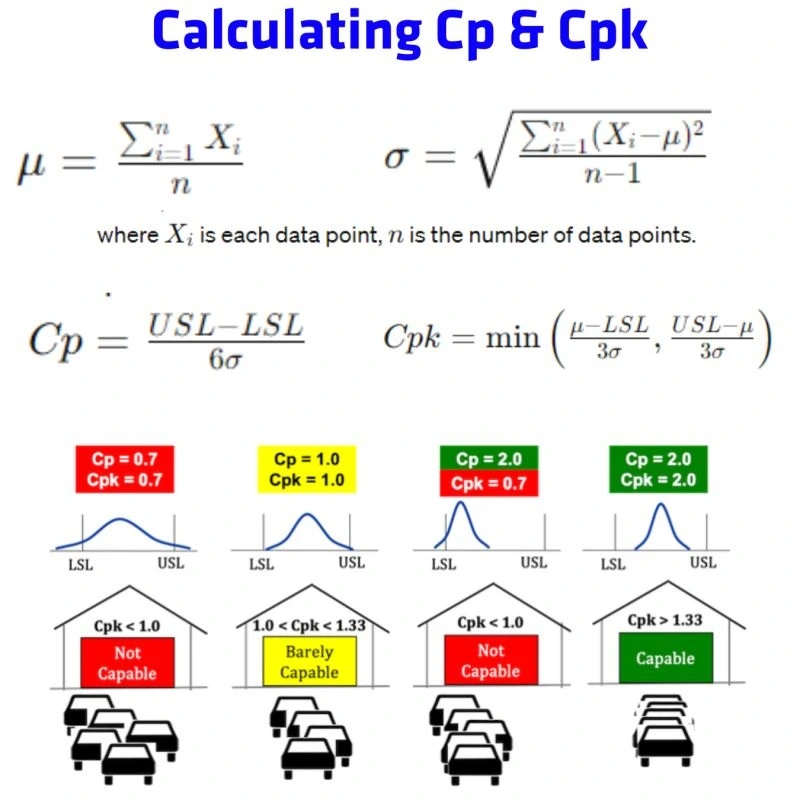
Executive takeaway
Cp/Cpk are not marketing numbers. They only have meaning when the process is:
- in statistical control,
- measured with a capable measurement system,
- and based on a coherent sampling plan.
In machining, the biggest “fake capability” drivers are:
- thermal transients,
- tool wear drift,
- re-clamping multi-modal distributions,
- and measurement inconsistency.
What capability indices assume (often violated)
Capability analysis typically assumes a stable distribution around a mean with consistent variation. If your process mean drifts during a run, Cp/Cpk will be inflated and misleading.
CNC-specific red flags (what buyers should question)
- Capability shown only on 5 parts from the best window
- No evidence the process was in control (no SPC, no drift checks)
- No mention of thermal state or tool life window
- Mixed measurement methods across the dataset
- Rework parts included without documentation
How to do Cp/Cpk in a CNC shop without fooling yourself
Step 1 — qualify measurement first
Run GR&R and lock measurement method.
Step 2 — define the “process window”
A capability study must state:
- machine and program revision
- tool life window (new tool vs end of life)
- thermal state (warm-up and restart rules)
- material lot class
Step 3 — subgroup logically
Subgrouping should reflect how variation behaves:
- consecutive parts in the same setup and thermal band are meaningful
- mixing different setups is not
Step 4 — attach reaction plans
Capability should connect to control:
- what actions keep it stable
- what triggers requalification
Buyer evidence pack
- Capability report with declared preconditions
- SPC evidence that the process was in control
- Measurement system evidence (GR&R)
- Change control and requalification triggers
FAQ for buyers
- Why can Cp look good but customer still gets bad parts?
- When should a supplier refuse to provide Cpk?
- How do you prove the process is stable in a high-mix environment?
- What is the difference between short-term and long-term capability?