
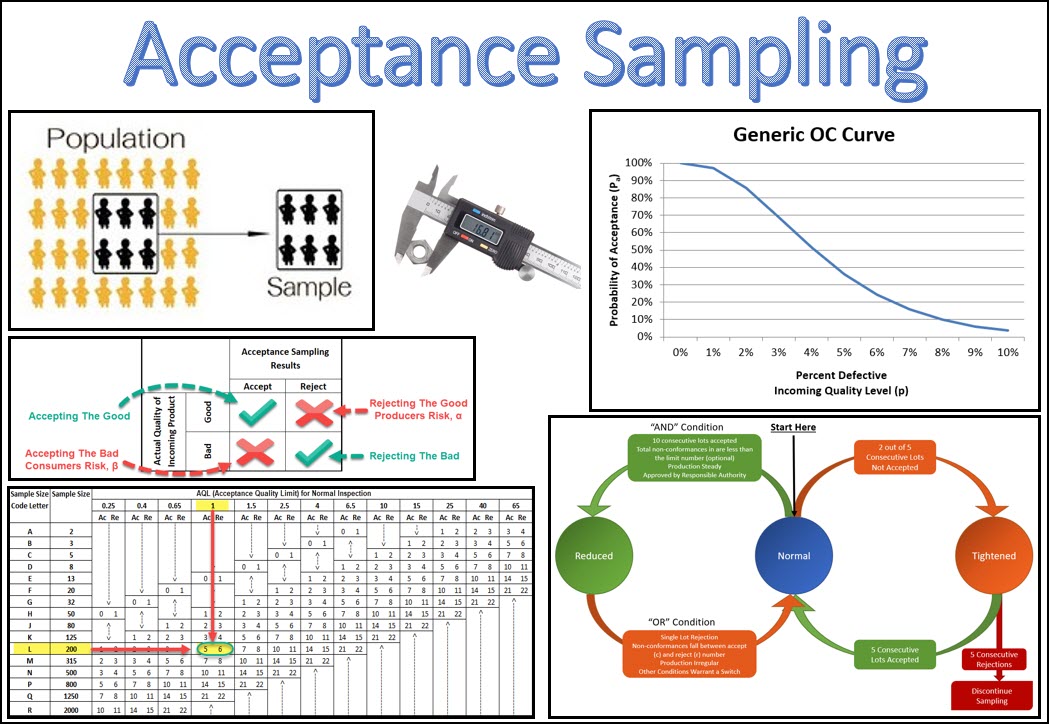
Executive takeaway
AQL sampling is not a substitute for process control. It is a structured way to manage inspection effort relative to risk.
The key practical decision:
- use attributes sampling (Z1.4) when inspection is pass/fail or variable measurement is not reliable,
- use variables sampling (Z1.9) when you can measure CTQs with a capable system and want higher efficiency.
Z1.4 (attributes) vs Z1.9 (variables): practical meaning
Z1.4 — acceptance sampling by attributes
- Decisions based on number of defectives or defects
- Appropriate for visual issues, burr present/absent, cosmetic classification
- Includes switching rules (normal / tightened / reduced)
Z1.9 — acceptance sampling by variables
- Decisions based on measured values and estimated percent nonconforming
- Appropriate for dimensional CTQs when measurement is capable
- More information per sample; often allows smaller sample sizes for the same risk
The common CNC mistake: sampling CTQ like cosmetic
CTQs (especially aerospace and semiconductor-adjacent):
- often need stricter inspection levels
- sometimes require 100% inspection on specific characteristics
- often require decision rules (uncertainty) near limits
If a supplier applies a blanket AQL to everything, the buyer will (rightfully) question risk coverage.
Building a sampling matrix that buyers accept
- Classify characteristics:
- CTQ (functional/safety/seal/fit)
- Major
- Minor
- Assign inspection approach:
- CTQ: variables sampling with capable measurement, or 100% where justified
- Major: Z1.9 or Z1.4 depending on measurability
- Minor: Z1.4 typically
- Define switching logic and containment rules:
- normal → tightened if defects appear
- reduced only when stable, documented, and approved
Buyer evidence pack
- Sampling matrix by characteristic class
- Proof measurement supports variable sampling (GR&R evidence)
- Clear reaction plan when defects found (containment and escalation)
FAQ for buyers
- When should we use Z1.9 instead of Z1.4?
- How do switching rules protect buyers over time?
- What is your approach for CTQ characteristics—AQL or 100%?
- How do you avoid sampling blind spots in a high-mix shop?